
Teacher Portal
Investigation 3: PostLab
Maternal-Fetal Interaction
PostLab Assessment — Investigation 3
Download and administer after completing the Investigation.

Focus Questions:
1. Why is mitosis essential for human growth and development from a single cell to a multicellular organism?
Human prenatal development depends on a sequence of biological processes that occur in a precise, regulated, and highly coordinated manner. From the moment of fertilization, development proceeds through predictable stages that rely on accurate cell division, controlled gene expression, and regulated cell differentiation. Cells do not divide randomly; they follow internal instructions that determine when to divide, how often to divide, and what type of cell to become.
This orderliness allows complex structures—such as tissues, organs, and body systems—to form in the correct locations and proportions. Even small deviations from these regulated processes can disrupt development, which highlights how tightly controlled prenatal growth must be. The remarkable reliability of human development across billions of individuals underscores that these processes are governed by biological laws rather than chance.
Discussion angles students may raise:
• “Everything happens in steps.”
• “Cells have instructions.”
• “It’s not random.”
• “Things grow in the right order.”
Teacher move:
Affirm these ideas and emphasize control, regulation, and coordination.
2. How do chromosomes ensure that genetic information is accurately copied and distributed during cell division?
Chromosomes organize DNA into compact, manageable structures that allow genetic information to be copied and separated with precision. Before a cell divides, each chromosome is duplicated, forming two identical sister chromatids. During mitosis, specialized cellular mechanisms ensure that these chromatids are pulled apart evenly so that each new cell receives a complete and identical set of genetic instructions.
This accuracy is essential because every new cell must contain the same information needed to function properly and contribute to the developing organism. Errors in chromosome duplication or separation can lead to serious developmental problems, demonstrating that chromosome behavior during mitosis must be tightly regulated rather than left to chance.
Discussion angles students may raise:
• “The DNA has to be copied first.”
• “Each cell gets the same instructions.”
• “Mistakes would cause problems.”
• “There’s a system that checks the process.”
Teacher move:
Highlight precision and error prevention in chromosome replication and separation.
3. What is the placenta, and how does it function as a site of exchange between mother and developing child?
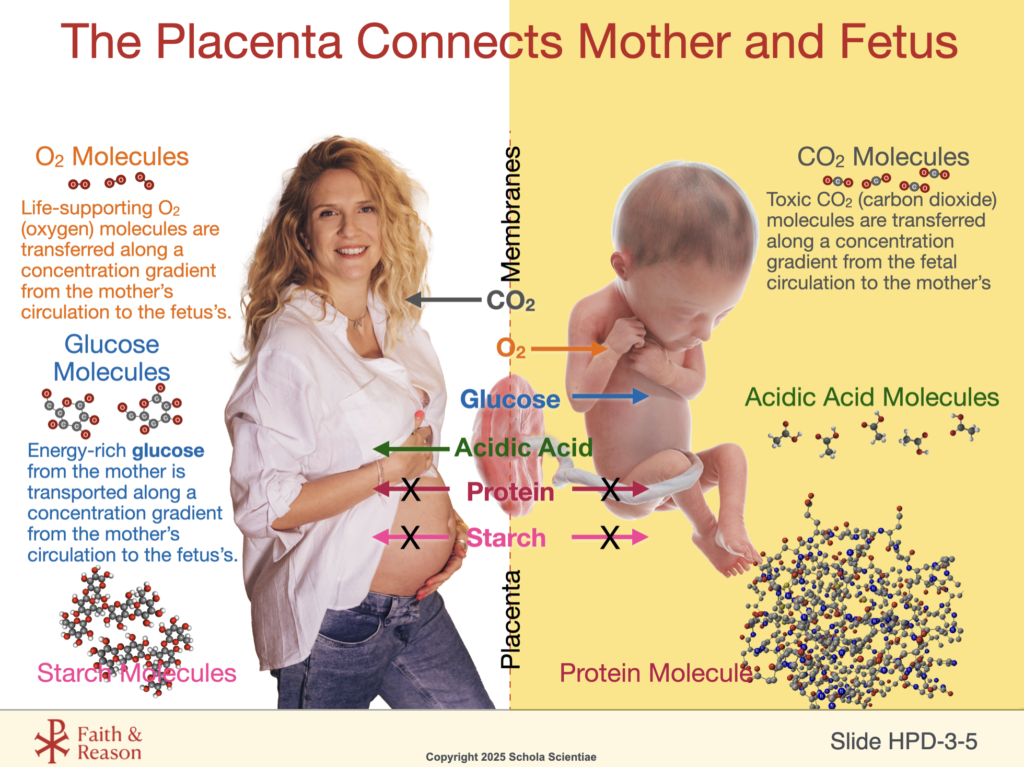
The placenta is a temporary organ that forms during pregnancy and connects the developing child to the mother. It allows oxygen, nutrients, and other essential substances to move from the mother’s bloodstream to the developing child, while carbon dioxide and metabolic wastes move in the opposite direction. Importantly, maternal and fetal blood do not normally mix.
Instead, exchange occurs across specialized placental structures that keep the two circulatory systems separate while still supporting growth and development. This arrangement protects both mother and child while ensuring that the developing organism receives what it needs to survive and grow.
Discussion angles students may raise:
• “The blood doesn’t mix.”
• “Stuff moves both ways.”
• “The baby depends on the placenta.”
• “It’s like a connection point.”
Teacher move:
Emphasize separation with connection and the placenta as a regulated exchange interface.
4. Why is the placenta more accurately described as a selective interface rather than a simple filter?
A simple filter separates materials based mainly on size, allowing smaller particles to pass through while blocking larger ones. While this idea can help model certain aspects of exchange, it does not fully explain how the placenta works. Some large molecules are transported across the placenta, while some smaller substances are blocked or tightly regulated.
The placenta uses specialized biological mechanisms to control what passes through, when it passes through, and in what direction. This selectivity allows the placenta to support life in ways that mechanical filtration alone cannot explain, revealing the limitations of simple models when describing living systems.
Discussion angles students may raise:
• “It’s not just size that matters.”
• “Some things are allowed and others aren’t.”
• “The model doesn’t explain everything.”
• “Living systems are more complex.”
Teacher move:
Reinforce the idea that models are useful but limited, and that biological systems involve active regulation rather than passive filtering.
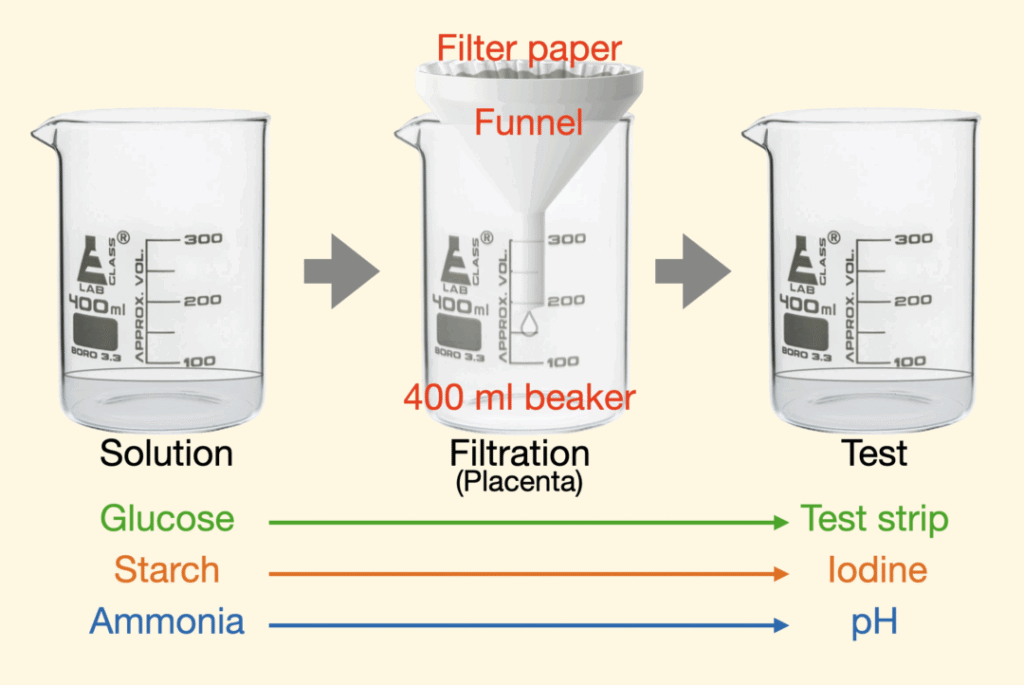
5. How did the lab activity help you model how materials move between the mother and the developing fetus through the placenta?
By physically modeling placental exchange, students were able to transform an invisible biological process into a concrete experience. The lab demonstrated that materials such as oxygen and nutrients move from the mother’s blood toward the fetus while waste products move in the opposite direction, all without the two blood supplies directly mixing. This helped students understand the placenta as both a connection and a barrier.
The activity also showed how diffusion and selective permeability work together to regulate what can pass through the placental interface. Students observed that some substances moved easily across the barrier while others were restricted, reinforcing the idea that the placenta carefully controls exchange rather than allowing free flow.
Overall, the lab reinforced the central idea of the Investigation: the placenta is a specialized structure that protects the developing fetus while allowing essential materials to pass reliably over time. Modeling this process helped students connect structure, function, and biological purpose.
Discussion angles students may raise:
“The mother’s and fetus’s blood never actually mixed.”
“Only certain things were able to pass through the barrier.”
“The placenta acts like a filter instead of a pipe.”
Teacher move:
Emphasize that scientific models help us understand processes we cannot see directly, while also reminding students that models simplify reality. Reinforce that the real placenta is far more complex, but the lab captures its essential function: controlled exchange without direct blood contact.
Think Critically:
How teachers should use these answers
Do not read them aloud verbatim. Use them to:
- Probe student reasoning
- Redirect misconceptions
- Connect answers back to the Lab experience
Encourage students to explain why, not just what
1. Imagine that the placenta allowed all substances to pass freely between the mother and the developing fetus. What specific problems might arise during prenatal development?
If the placenta were not selectively permeable, harmful substances such as toxins, pathogens, or excess hormones could enter the fetal bloodstream. Because the fetus is still developing protective systems, even small amounts of harmful materials could interfere with normal growth and organ formation.
Without selective control, the fetus could also experience imbalances in oxygen, nutrients, or waste removal. This would disrupt the stable internal environment required for development. The placenta’s ability to regulate exchange is essential for protecting the fetus while still supporting growth.
Key teaching point:
Protection during prenatal development depends on controlled exchange, not unrestricted access.
Possible student responses to affirm and extend:
“Bad substances could reach the fetus.”
“The fetus wouldn’t be protected.”
“Too much or too little could pass through.”
2. During the Lab, you modeled how materials moved across a barrier without direct mixing. Why is it important that the mother’s and fetus’s blood supplies remain separate?
Keeping the mother’s and fetus’s blood supplies separate helps prevent immune reactions and allows each circulatory system to function independently. Direct mixing could trigger the mother’s immune system to recognize fetal cells as foreign, potentially harming the pregnancy.
The Lab helped students visualize how exchange can occur efficiently across a barrier without direct contact. This reinforces the idea that biological systems often rely on separation combined with controlled interaction.
Key teaching point:
Separation and connection can occur simultaneously in biological systems.
Possible student responses to affirm and extend:
“The blood never touched.”
“Mixing could cause problems.”
“The barrier keeps things safe.”
3. The Lab model simplified the structure of the placenta. Why do scientists use simplified models when studying complex biological systems like prenatal development?
Simplified models allow scientists to focus on essential functions without being overwhelmed by complexity. By isolating key ideas—such as diffusion, selective permeability, and controlled exchange—students can understand the core purpose of the placenta before learning more detailed anatomy.
Models also help scientists test ideas, communicate concepts, and make predictions. While no model captures every detail, each one provides insight into how real systems work.
Key teaching point:
Models are tools for understanding essential functions, not exact replicas of reality.
Possible student responses to affirm and extend:
“It’s easier to understand.”
“You can focus on one idea at a time.”
“Real systems are too complicated to copy exactly.”